
If you are planning a move in Singapore, it is very easy to compare movers by one thing only: price.
That is exactly where many people go wrong.
On the surface, moving services can look like a commodity. A truck is a truck, boxes are boxes, and a few people show up to carry things. But in reality, there can be a huge difference in the professionalism, capability, accountability, and care provided by one moving company versus another.
And when something goes wrong, the cheapest quote often becomes the most expensive decision.
Whether you are moving a studio apartment, a landed house, an office, or a home filled with high-end furniture, art, designer pieces, electronics, fragile items, or sentimental belongings, choosing the right mover matters far more than many people realise.
In this guide, we break down some of the most common tricks and corner-cutting tactics used by unscrupulous local movers in Singapore, what questions to ask before booking, and why moving should never be treated as a one-size-fits-all service.
Why “cheap movers” can cost you more
Many customers search for terms like “cheap movers Singapore” or “best moving company Singapore” and then compare only the headline number in the quotation.
That is understandable. Moving is already expensive, and everyone wants value.
But a low quote can hide all sorts of problems:
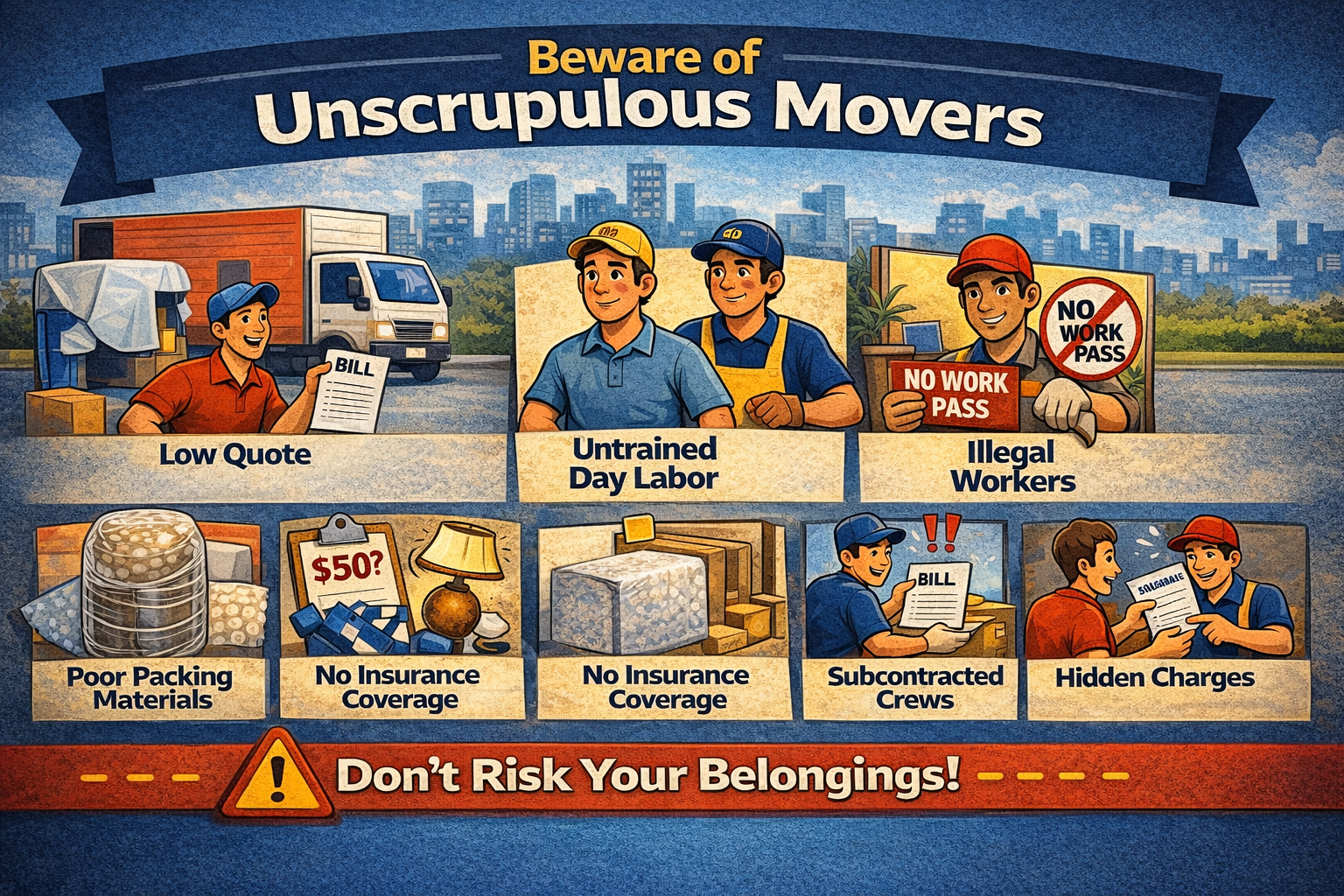
- extra trips that should have been avoided
- hidden charges that appear on moving day
- insufficient manpower
- poor packing materials
- careless handling
- no meaningful damage protection
- subcontracted crews with little accountability
- delays that disrupt your entire schedule
The real question is not just, “How much does the move cost?”
It is, “What am I actually getting for that price?”
Common tricks some unscrupulous movers use

1. Extra trips caused by bad estimating or deliberate underquoting
One of the oldest tricks in the book is quoting too small a vehicle, too little manpower, or too optimistic a plan.
Sometimes this happens because the mover did not estimate properly. Sometimes it happens because they wanted to win the job with a lower number and deal with the consequences later.
The result? You are told on moving day that the load does not fit, that another trip is required, or that there will be extra charges because the original quotation was based on “less volume than expected”.
In some cases, crews also fail to load the vehicle efficiently. This does not mean a truck should be overloaded in an unsafe manner. But it does mean the mover should know how to load properly, maximise the available safe space, and plan the move with experience and discipline.
A professional mover should be able to assess the job with reasonable accuracy and avoid unnecessary extra trips. When extra trips happen because of poor planning, the customer should not be the one paying for the mover’s lack of competence.
2. Day labour with little accountability
A lot of movers rely heavily, or almost entirely, on casual day labour.
The problem is not simply that workers are paid by the day. The problem is accountability.
If the crew handling your marble dining table, designer sofa, or fragile glass cabinet consists of whoever was available that morning, you may be dealing with people who:
- do not know the company’s standards
- are not trained consistently
- are not used to working together
- have no long-term accountability for mistakes
- may never be seen again if something goes wrong
That is very different from a team of full-time staff who are trained, supervised, evaluated, and held responsible for how items are packed, handled, transported, stored, and delivered.
3. Workers who may not even be lawfully deployed for the job
Customers should also be cautious about movers using workers who may not have the proper authorisation to do the work being assigned.
In Singapore, the Ministry of Manpower states that Work Permit holders are only allowed to work for the employer and in the occupation and sector specified in their Work Permit. MOM also states that employing a foreign employee without a valid work pass can lead to fines of between S$5,000 and S$30,000, imprisonment of up to 12 months, or both.
That does not automatically mean a customer will be liable every time a mover has a manpower compliance issue. The primary legal responsibility sits with the employer. But from a customer’s perspective, it is still a major red flag. If a mover is prepared to cut corners on staffing legality or compliance, what else are they willing to cut corners on?
At a minimum, it raises serious questions about professionalism, risk management, and whether you want those people handling your possessions inside your home or office.
4. Poor packing materials dressed up as “protection”

Many movers use stretch wrap on everything.
Stretch wrap has its uses. It can help hold drawers shut, keep dust off surfaces, or keep padding in place. But by itself, it is not real protection.
Likewise, many customers assume bubble wrap is the gold standard. It is not. Bubble wrap can be useful in certain situations, but contrary to popular belief, it is not suitable on its own for many very fragile, delicate, or high-value items. For some items, it provides less protection than customers assume and can create a false sense of security.
Truly fragile items often need more thoughtful methods, such as proper cushioning, corner protection, rigid support, carton selection, internal fill, or specialised handling techniques depending on the item.
If a mover’s entire “protection system” is just stretch wrap and a bit of bubble wrap, that is not careful packing. That is speed masquerading as care.
5. Little or no real insurance or damage allowance
This is one of the biggest issues in the industry.
Many movers do not carry meaningful insurance for customers’ goods, or they rely on terms that leave the customer with almost no practical protection if something is damaged.
Some even say things like they provide “up to S$50” or “up to S$100” in coverage. For a move involving furniture, appliances, electronics, antiques, artwork, or personal effects, that is almost insulting.
Customers should read the fine print carefully. In Singapore, consumers are already familiar with service providers whose terms place much of the risk back on the customer. In one reported case involving storage, the company’s terms stated that goods were stored at the sole risk and responsibility of the customer, while additional insurance was merely recommended if the basic protection was inadequate.
The lesson is simple: do not assume that because a company is handling your items, they are genuinely standing behind the risk.
Ask:
- What exactly is covered?
- Is it insurance, limited liability, or just goodwill?
- What are the exclusions?
- Is packing damage excluded?
- Is there any compensation schedule?
- What happens in practice if something is scratched, chipped, cracked, or broken?
If the answers are vague, that is your answer.
6. Hidden charges that appear only when the crew arrives
Another common problem is the low initial quote that grows rapidly once the movers are on site.
Common examples include:
- staircase charges
- long push charges
- bulky item surcharges
- waiting time fees
- dismantling and reassembly fees
- charges for wrapping materials
- fuel or ERP surcharges
- after-hours fees
- extra charges because the lift is small or access is inconvenient
Some of these may be legitimate if clearly disclosed upfront. The issue is when they are not.
A professional mover should ask the right questions in advance: Are there stairs? Is there a lift? Is there a long distance from loading point to unit? Are there condo booking rules? Are there oversized items? Are there access restrictions? Is special handling required?
If they did not ask, but later want to charge you for it, be careful.
7. Subcontracting the actual move to someone else
Some companies market aggressively, sound polished on WhatsApp, and close the sale quickly, but the actual job is then handed off to a different crew or subcontractor.
Now the company you thought you hired may not be the company doing the move.
That can create problems with:
- service quality
- accountability
- consistency
- damage claims
- communication
- timing
- training standards
There is a big difference between a company that operates the move and a company that merely sells the move.
8. Rushing the job to fit more jobs into the same day
A mover trying to squeeze multiple jobs into one day may rush packing, loading, transport, unloading, and placement.
That is when you see:
- furniture dragged instead of lifted
- parts mixed up
- screws and fittings lost
- items stacked poorly
- fragile pieces loaded in the wrong sequence
- walls, doors, and floors scraped
- boxes crushed under heavier items
Fast is good only when it comes from experience and systems. Fast because the team is cutting corners is expensive.
9. Vague quotations with no real scope
If a quotation is too short, too general, or missing key assumptions, that is dangerous.
A proper moving quote should ideally make clear:
- origin and destination
- estimated volume or item list
- truck size or move plan
- manpower
- access assumptions
- packing or wrapping included
- dismantling/reassembly included or not
- timing assumptions
- exclusions
- extra charge triggers
- damage/coverage terms
A vague quote gives the mover more room to reinterpret the job later.
10. Large deposits with weak recourse if something goes wrong
This is not unique to movers, but it is still worth mentioning. In Singapore, CASE said consumers suffered about S$1.93 million in prepayment losses in 2024, with many losses tied to companies becoming unresponsive or shutting down after taking deposits. CASE also provides a complaint route for consumer-to-business disputes involving goods or services bought for personal or domestic use.
That report was not about movers specifically, but the consumer lesson is relevant: be careful about paying substantial amounts upfront to businesses that have weak accountability, poor documentation, or questionable operating standards.
Why moving is not a commodity
People often compare movers as though every company is fundamentally the same.
They are not.
A basic low-risk move involving inexpensive, replaceable items is one thing.
A move involving any of the following is something else entirely:
- high-end furniture
- luxury goods
- antiques
- art
- glass and stone pieces
- electronics
- business equipment
- sentimental items
- awkward access conditions
- storage as part of the workflow
- multiple stages such as collection, moving, storage, and re-delivery
The more valuable, fragile, logistically complex, or time-sensitive the job is, the less sensible it becomes to choose based only on the cheapest quote.
The mover should be chosen based on the actual requirements of the job.
What to look for in a responsible moving company in Singapore
Here are some signs you are dealing with a more serious operator:
- they ask detailed questions before quoting
- they assess access, stairs, lift usage, and long-push conditions
- they explain what packing materials are actually used
- they are transparent about what is and is not included
- they provide a clear process for fragile or high-value items
- they can explain their crew structure and supervision
- they have real operational accountability
- they have a sensible claims or damage policy
- they can handle both moving and storage workflows properly when needed
How BEAM Space approaches moving differently
At BEAM Space, we come at moving from a different starting point.
Our crew are full-time staff accustomed to handling a wide variety of items carefully and responsibly. That matters.
Because our business has long required us to be responsible for customers’ belongings not just during transport, but across the full chain of collection, moving, storage, inventory handling, and eventual delivery, our operational mindset is built around care, traceability, supervision, and accountability.
This is not a side issue for us. It is fundamental to how we operate.
That means:
- crews who are used to handling items carefully
- multiple levels of supervision and accountability
- operational processes shaped by long-term responsibility for goods
- experience dealing with everything from ordinary household items to more delicate and higher-value possessions
- a service mindset that recognises moving is not just about getting items from Point A to Point B, but doing so properly
When a company has to remain responsible for items over long periods of time, not just a few hours on moving day, it tends to develop a more careful culture. That experience carries over into our moving services.
Questions to ask before you book any mover
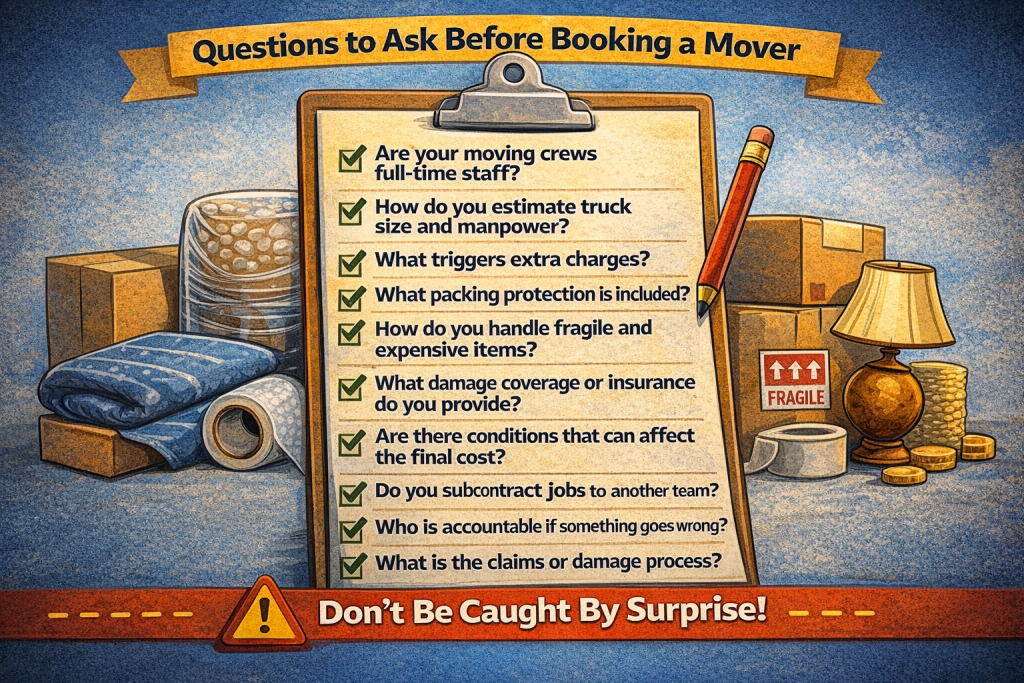
Before confirming a mover, ask these:
- How did you estimate the required truck size and manpower?
- Under what circumstances would extra trips be charged?
- Are the moving crew full-time staff, subcontractors, or day labour?
- What protective materials are included?
- How are fragile and high-value items handled?
- What exactly is your damage policy?
- Is the quote fixed, and what specific situations would trigger extra charges?
- Will the same company I booked be the one performing the move?
- Have you accounted for stairs, lift access, long push distance, and building restrictions?
- If something goes wrong, who is accountable and how is it resolved?
If a mover seems irritated by these questions, that is useful information.
Final thoughts: the cheapest quote is not always the best value
A move is not just transport. It is trust.
You are allowing people into your home or office. You are trusting them with your furniture, appliances, valuables, documents, sentimental items, and schedule. You are trusting them not to create damage, delays, or nasty surprises halfway through the job.
So yes, price matters.
But professionalism matters too. Accountability matters. Care matters. Compliance matters. Packing matters. Claims handling matters. Supervision matters.
And when you compare movers in Singapore, those differences can be enormous.
If you are moving items that genuinely matter, choose a mover based on the requirements of the job, not just the lowest headline number.
Because when corners are cut, customers usually pay for it one way or another.